 Finlay Colville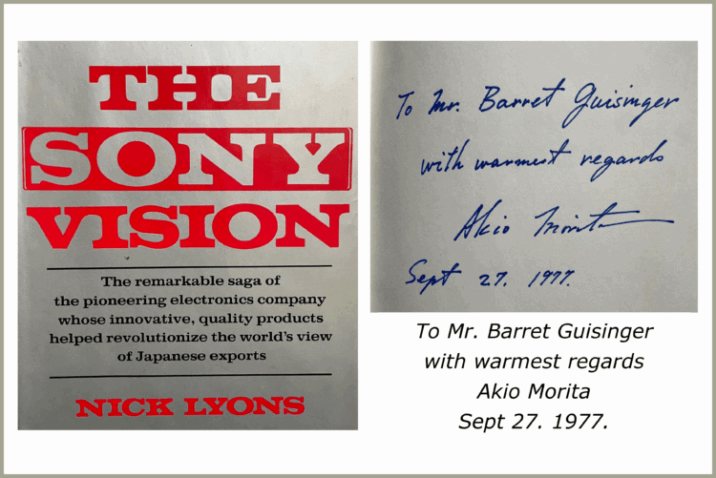
Just days into launching the Terawatt PV Research platform, I am instantly off on a tangent; but one that appears to be as fascinating as it is intriguing.
When I launched the web platform, one of the four ‘Resource’ categories was listed as ‘Book writing’. This part of the website was intended to form a logbook of the journey in writing a book on the history of manufacturing, technology and corporate strategy in the solar photovoltaics (PV) industry; in particular, leading up to annual production rates reaching the terawatt level.
I concluded the introductory article on the ‘Book writing’ topic, Chasing the terawatt dream – how mass production revolutionised solar photovoltaics, with this closing text:
[The] collective national strategy in Japan for solar PV included the above-mentioned Japanese companies [Sanyo, Sharp, Kyocera and Mitsubishi Electric] and the Ministry of International Trade and Industry (MITI, the former METI) and largely followed an industrial and manufacturing blueprint that had been the cornerstone of Japanese technical supremacy on the global stage during the second half of the twentieth century.
I can’t think of a more exciting place to start the book writing project.
The mysterious book
For years, I have been curious why two of Japan’s Big Four of consumer electronics (Sharp and Sanyo) were the main drivers behind Japan’s prominent role in the first growth phase of the solar PV industry: and why the other two (Matsushita and Sony), the true powerhouses of Japan’s global dominance in consumer electronics of the twentieth century, were not involved.
The book writing project is a great excuse to read books written by other people; my starting point is to research the solar PV book by only reading ‘physical’ books (or journals, magazines, etc.).
After some background research, the first batch of books (purchased second-hand through online sellers) for this learning phase on Japan’s Big Four of twentieth century consumer electronics (Sharp, Sanyo, Matsushita and Sony) arrived in the post, including books about: Konosuke Matsushita (whose companies and brands included Matsushita Electric, National, JVC, Technics and Panasonic); Toshihiko Yamashita (the president of Panasonic from 1977, a prescient year as we will find out); and Akio Morita (the co-founder and former Chairman and CEO of Sony).

When I opened The Sony Vision, written by Nick Lyons in 1975, I immediately came across a handwritten dedication on the opening page of the book.

Normally, handwritten additions to books (especially when acquired second-hand) have no context to the new owner: however, on this occasion, I was gripped.
To Mr. Barret Geisinger
with warmest regards
Akio Morita
Sept. 27. 1977.
Is this a book signed by the Sony co-founder and former Chairman and CEO, Akio Morita, possibly the most famous Asian entrepreneur of all time, whose company and leadership thereof has nothing short of legendary status?
Any doubts I had on this were put on hold when I then found a mysterious envelope tucked into the rear cover of the book, shown below:

The envelope was official Sony Corporation (Tokyo) headed, with the name of Mr. B. Guisinger having clearly been written using a typewriter. I opened the envelope and found these two items.
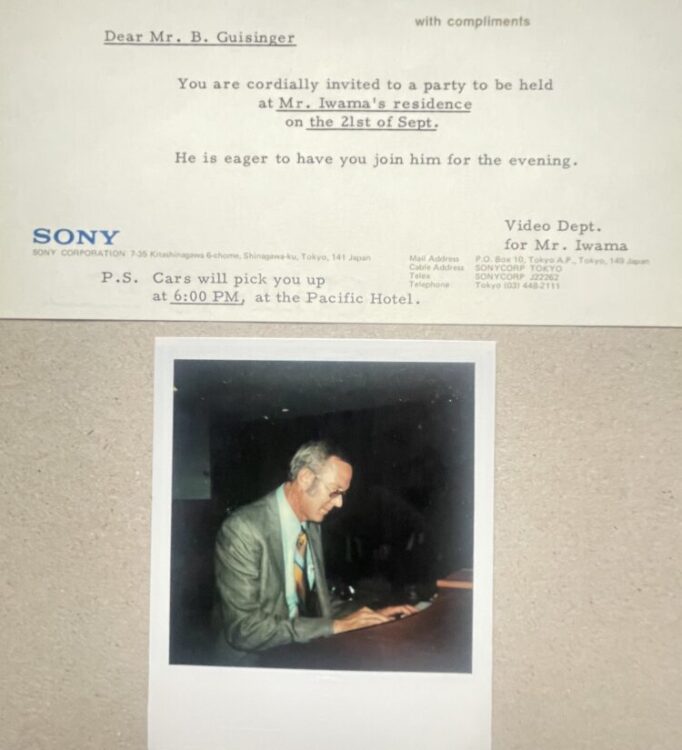
One of the items was an evening invitation to the residence of a Mr. Iwama. Was this Kazuo Iwama, who was instrumental in Sony developing the know-how to mass produce low-cost transistors for its portable radios, and was famously sent to the U.S. after Sony acquired the patent from Western Electric in 1954?
Mr. Iwama had been the president of Sony Corporation since 1976, having managed operations at the Sony Corporation of America from 1971 to 1973; and in just two years (1979), would be awarded the Blue Ribbon Medal from Emperor Hirohito (for contributions to the electronics industry).
As for the location to collect Mr. B. Geisinger, the Pacific Hotel: was this the Hotel Pacific Tokyo that was owned by railroad company Keikyu Corporation and operated by a hotel subsidiary between 1971 and 2010, before the building was demolished a few years ago?
The other item was a photograph (instant-camera taken, like many Polaroid photos still in my procession by virtue of growing up in the 1970s). This showed a man, dressed smartly, (possibly) playing a keyboard instrument.
By now, my doubts on the provenance of Mr. Morita’s signature had been quashed and I was simply curious about this Mr. B. Geisinger; not to mention how I had come into possession of this book almost 50 years later, buying it online for £15 (most of which was likely the postage from overseas).
Before the question of Mr. Geisinger (which is at the heart of this piece), let’s have a look at what was happening at Sony in 1977 that would have formed the context of a book on the company being signed by its co-founder, Akio Morita, and the recipient keeping a personalised invitation to the residence of Mr. Iwama and (presumably) adding a picture to the envelope that contained the invitation.
While being a market analyst covering the solar industry is incredibly exciting, what I would give to have done this during the 1970s and 1980s in the consumer electronics industry, and through the analog-to-digital transition thereafter.
Too often, one’s perception of the past is influenced by what happened after; it is very easy to be wise-after-the-event. Therefore, to fully understand what it was like working at Sony in 1977, I had to get back there, and there is only one way to do this.
Adhering to a classic line from a film in 1985 (‘all the best stuff is made in Japan’), I found a DeLorean, charged the flux capacitor, set the date to 27 September 1977, and accelerated to 88 mph, with strict orders not to disrupt the space-time continuum.
Here is the article I wrote back in 1977 during my recent time travels.
Sony 1977 revenues exceed $2B; Trinitron remains key offering, Betamax VCR gaining traction, Pulse Code Modulation processer released
As 1977 draws to a close, Sony continues to move from strength to strength, with turnover now breaking the $2B mark and rounding off continuous growth since 1970 when revenues were circa $400M.
To fully appreciate the company’s meteoric rise during the 1970s, I have digested the company’s annual reports over the past eight years. Listed now on 18 overseas stock exchanges, I chose the U.S. NYSE filings, with this listing having taken place in September 1970 (the first Japanese company to be listed in the U.S.).
I segmented annual revenues by geographic regions and provided a full analysis (backed out to 1970 factoring in business unit adjustments) of key product lines that are now instrumental to the company going forward. In addition, I have examined some of the activities at the R&D phase that suggest new market opportunities in the 1980s.
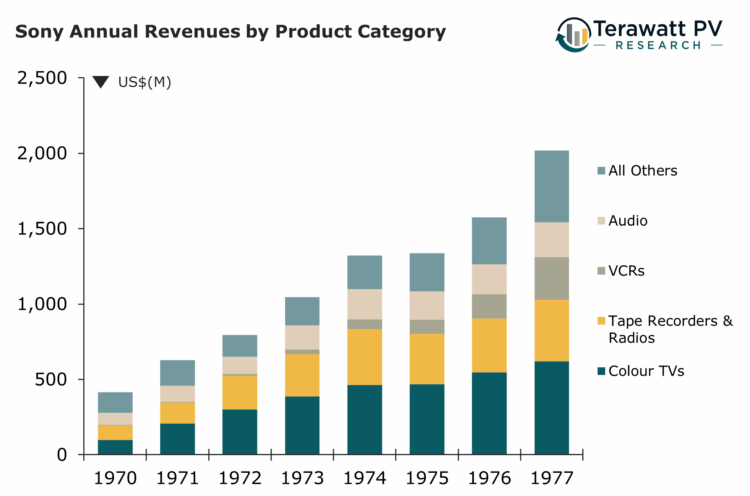
First, let’s look at the growth from 1970 to 1977, split by region to illustrate the focus on the U.S. market in recent times and by product to highlight the importance of colour TV sales (the Trinitron brand) and video cassette recorders (VCRs) that includes both industrial versions (the U-matic range) and the newly released consumer offering (the Betamax).
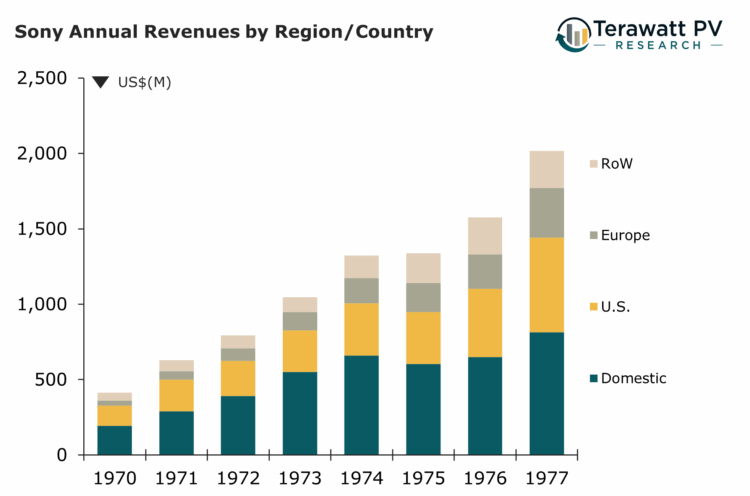
This year (1977), overseas revenues account for circa. 60% of revenues, with the U.S. being the key market for Sony. The decision to invest in the Trinitron assembly plant in San Diego (California) in 1971 – and subsequent expansions in 1973 and 1974, adding production of key components including picture tubes – would appear to be paying dividends for the company; this coming after concerns raised back in 1970 following the U.S. Treasury Department’s dumping determination for the imports of Japanese TV’s on a countrywide basis.
The growth of the company’s video cassette recorders (VCRs) since the development of this technology at Sony in 1969 – in particular, the launch of the consumer product (the Betamax) – now forms a key part of the company’s growth strategy following the production ramp in 1976. A two-hour model has just been released in Japan, with seven other companies aligning with the Betamax format for VCRs. A market created by the mass adoption of colour TVs globally, the opportunity for consumer VCRs is expected to be significant.
However, from a revenue and profits perspective, the period from 1970 to 1977 has been dominated by colour TV sales, with Trinitron sets moving progressively to larger screen sizes (including the 30-inch development in 1976), while resolution and picture quality has been improved significantly.
This year (1977) also saw the release of the company’s first Pulse Code Modulation (PCM) digital audio processer (the PCM-1) with analog-to-digital and digital-to-analog converters, mainly being adopted by audio enthusiasts and professionals at this point. This comes on the back of Sony’s R&D investments since the early 1970s, as a key focus at the Sony Research Institute.
Sales of tape recorders and radios have remained a consistent winner for the company since 1970, with a focus on portability and miniaturization a recurring theme.
With Sony expanding its marketing efforts through its flagship ‘showrooms’ in strategically-chosen locations (including on Fifth Avenue in New York, Champs-Elysées Avenue in Paris, and Regent Street in London) – while eyeing further overseas manufacturing facilities (including plans to double the footprint for magnetic tapes at Dothan, Alabama) – it will be fascinating to see how the company evolves towards the end of the decade and into the 1980s with new product offerings.
Back in 2025 and The Sony Vision book
In the coming years (after 1977), Betamax would lose out to Matsushita’s JVC video home system (or VHS) format, a global contest that dated back to the 1960s (also including RCA’s V-2000 and Philips’s Video Disc); a period that was transitional for Japanese electronics-based companies as VCRs replaced colour TVs as the new major growth market to pursue.
However, Sony would end up the ‘ultimate’ winner in this technology ‘segment’. Aligning its PCM technology with Philips’s optical laser capabilities allowed the two companies to define the global standard for the audio compact disc (CD) and further commercialize the CD-ROM (read-only memory) and the digital video disc (DVD).
Within two years (1979), Sony would release a product that represented the definitive statement of the company’s pioneering background in electronic tape-based products (dating back to 1954) and electronics miniaturization; the Walkman. The success of the Walkman would represent Sony’s third significant market-leading consumer electronics product, after the transistor radio (1955) and the Trinitron colour TV (1968).
In broad terms, the ten-year period from 1975-1985 epitomized Japan’s triumph in consumer electronics and was largely based on technologies developed by Sony. In this context, I hope that I have captured the climate of 1977 and at this point, I return to the topic of this post, The Sony Vision book in my possession.
While thrilled to bits having such a piece of ‘history’, this book belongs with its original owner/family or in a locked cabinet at a Sony history museum.
And this is now the challenge. So, any help in doing this would be appreciated. Pending my success in rehousing the book, I will (hopefully) write a follow-up post on how things evolved from this point onwards.